
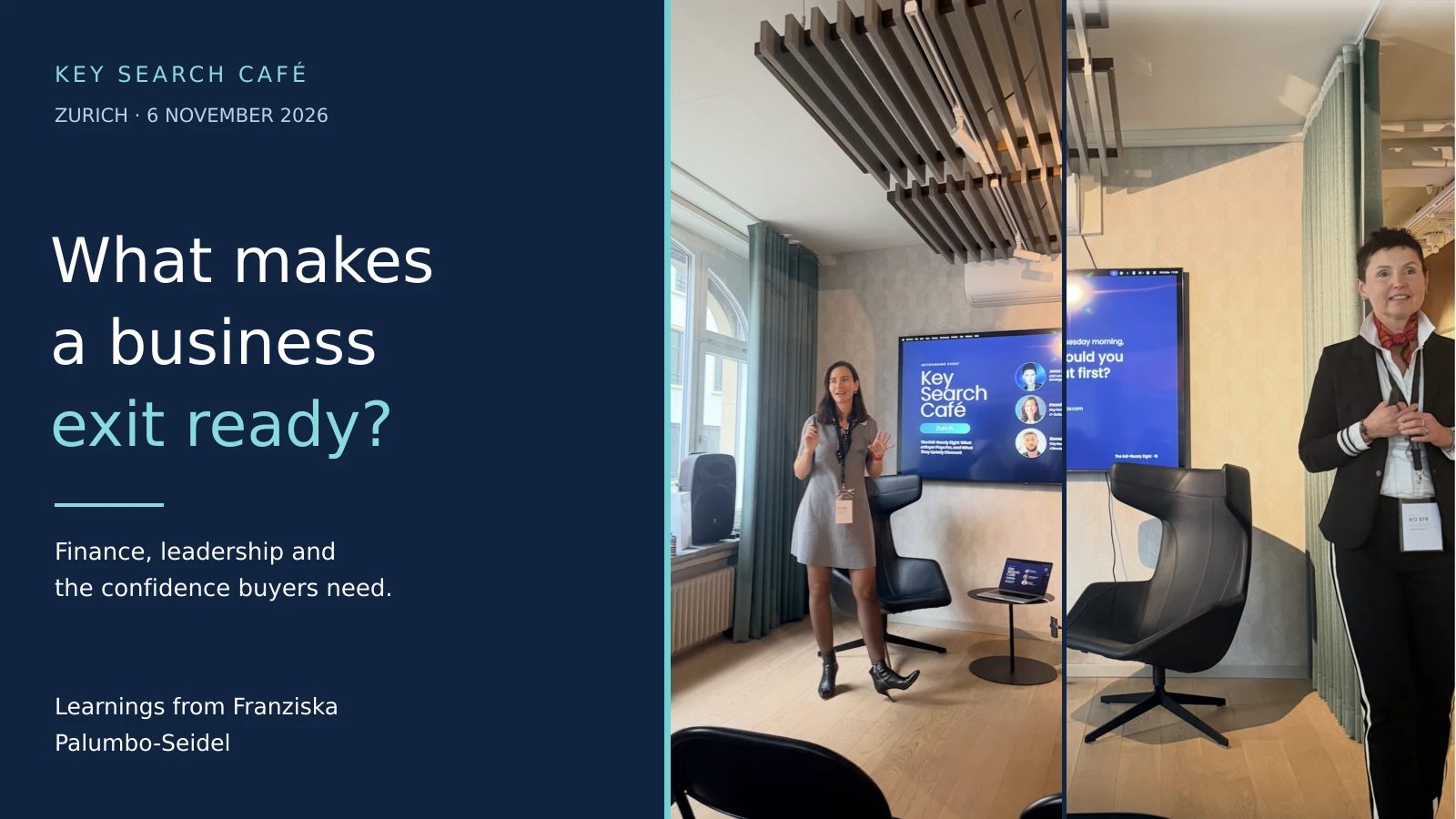
What Makes a Business Exit Ready? My Learnings from Key Search Café Zurich
Franziska Palumbo-Seidel shares what Jana Zimova’s Exit-Ready Eight taught her about financial confidence, founder independence and stronger FinTech leadership.
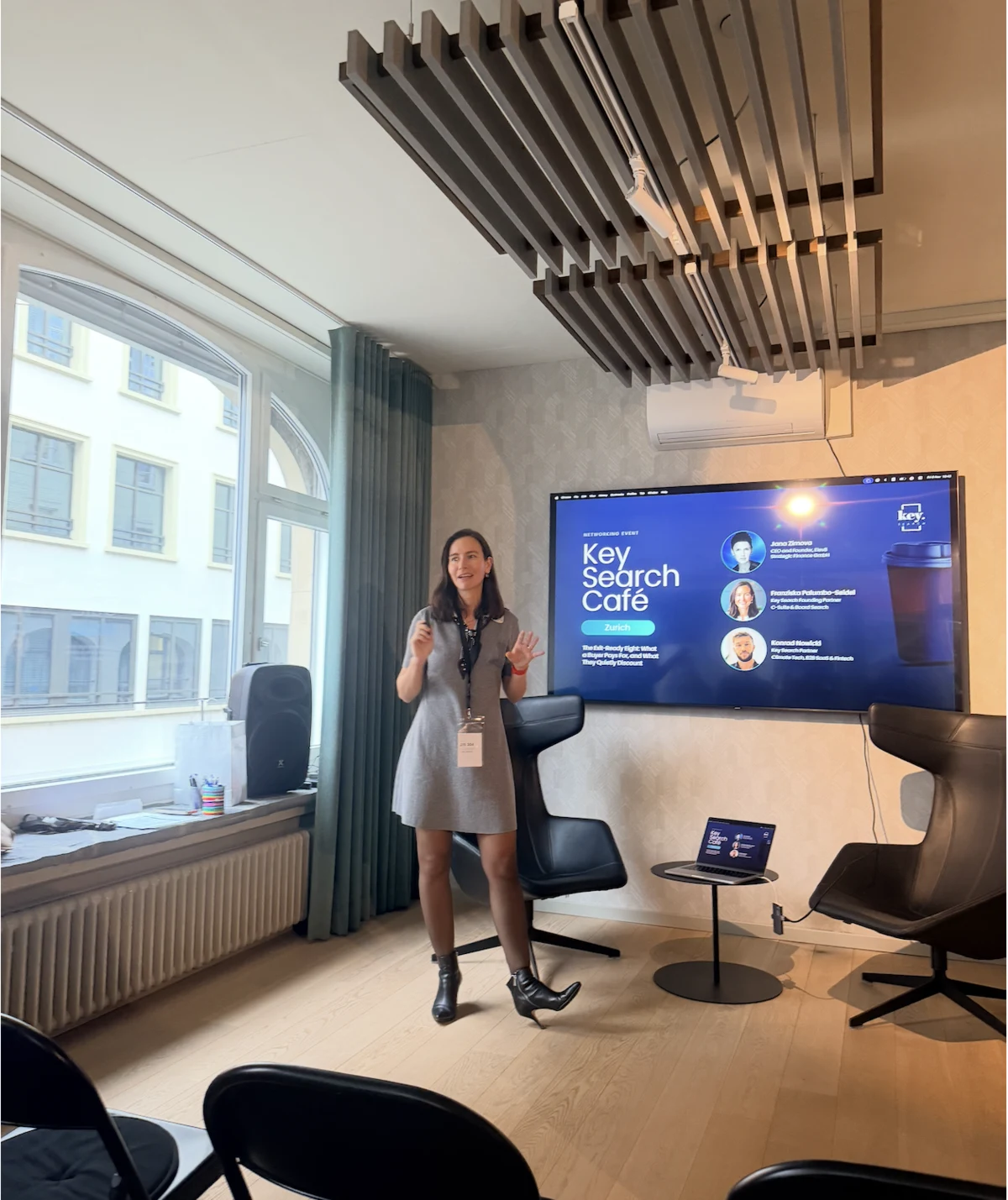
On Friday, November 6, we gathered for Key Search Café in Zurich. My session with Jana Zimova, CEO and Founder of Elev8 Strategic Finance GmbH, explored a question that matters well before a founder decides to sell: what makes a business ready for someone else to own?
Jana’s framework, The Exit-Ready Eight, looks at what a buyer pays for and what they quietly discount. I came away thinking about the connection between financial readiness and leadership. A business can have strong results and still depend on a handful of people, relationships or assumptions that a buyer cannot confidently take forward.
From my perspective in executive search, that makes exit readiness more than a finance project. It is also a test of the organization you have built.
1. Buyers need confidence in the earnings, not just an attractive number
One of Jana’s clearest messages was that earnings need to withstand scrutiny. Normalized EBITDA matters only if the adjustments behind it can be explained and defended. Owner compensation, related-party fees and one-off costs need evidence rather than a persuasive description.
Her opening illustration showed how inconsistent revenue figures across three systems could undermine confidence in earnings and reduce enterprise value. It was an illustrative scenario, not a reported transaction. The lesson was the relationship between reliable information and trust.
For me, the leadership implication is clear: a finance leader needs the authority and cross-functional support to establish one reliable version of the numbers. Hiring a strong CFO is not enough if the organization continues to work around disconnected systems.
2. Repeatable revenue needs resilient customer relationships
Jana distinguished revenue that recurs under contract from revenue that must be won again each quarter. She also challenged us to look at customer concentration. In her framework, a single customer contributing around 20% or more of revenue is a signal to examine dependence closely, not a universal valuation rule.
I would translate that into two questions for a leadership team: how dependable is our revenue and who actually owns our customer relationships? A major account can look secure while resting almost entirely on a founder’s personal involvement.
Commercial leadership should build broader relationships, understand renewal exposure and make customer knowledge accessible to the business. Those are operating disciplines as much as sales skills.
3. The founder absence test is also a leadership test
The question that stayed with me most was simple: could the business run for three months without its owner? Jana asked us to identify what would break. That is a more revealing starting point than a polished succession chart.
If every important decision, customer conversation or exception returns to one person, the business has not yet built enough independence. From an executive search perspective, the answer is not automatically another senior hire. It starts with understanding which decisions need a clear owner, which capabilities are missing and where authority has not genuinely been delegated.
A credible succession plan needs people who can act, not just names beside roles. That includes developing the team already in place and ensuring that new leaders have a mandate they can actually deliver.
4. Operational discipline becomes visible during diligence
Working capital, timely reporting and complete documentation can sound less compelling than a growth story. Jana’s session made their importance very concrete. A working capital shortfall against an agreed closing target can affect the price directly. Unfinished contracts, unclear intellectual property ownership or unresolved tax matters create uncertainty that buyers will seek to address.
Her reporting benchmarks included a five-working-day close, revenue that agrees across systems and a forecast with a credible track record. I see these as useful prompts for a leadership discussion rather than a one-size-fits-all standard for every business.
The broader lesson is accountability. Finance, operations, commercial teams and legal advisers need to work together before diligence exposes the gaps.

5. The growth story has to work without the founder
Jana described the need for a second act: a credible view of the first three years under new ownership. Past growth explains how a business arrived here. It does not, by itself, explain what a new owner can achieve next.
That distinction matters when building an executive team. Do you have leaders who can translate the next phase into clear choices about markets, products, channels and capital? Can they explain the assumptions and deliver the plan without relying on the founder to resolve everything?
The leadership team should be part of the evidence for the growth case, not a gap that a buyer has to fill later.
Why these learnings matter for FinTech leaders
These are my reflections on how Jana’s framework applies to FinTech, rather than a claim that her session was limited to the sector. For payments, lending and financial technology businesses, a credible growth story needs to sit alongside reliable reporting, clear accountability and an understanding of regulatory obligations.
A founder-led FinTech may need to strengthen finance, risk, compliance, technology or commercial leadership before a transaction or investment round. The right priority depends on the business model and stage. The important question is whether the team can demonstrate control while continuing to grow.
Our FinTech & Payments executive search practice works with businesses facing these leadership decisions. For me, the session reinforced the value of defining the capability you need before choosing the job title you want to hire.
What I would take into the next board conversation
- Identify the decisions and relationships that still depend on the founder.
- Check whether finance, commercial systems and management reporting tell the same story.
- Review customer concentration and the resilience of key contracts.
- Make succession and decision-making responsibilities explicit.
- Choose two weaknesses to address over the next 90 days and name an accountable leader for each.
Jana’s final question was a useful one: if a serious buyer arrived next Tuesday, which two of the eight areas would you rather they did not examine first? You do not need to be planning an exit to learn from the answer.
Thank you to Jana and everyone who joined us in Zurich. My biggest takeaway is that preparing for a future transaction can improve the business now. Better information, less dependence on one person and a team equipped for the next phase are valuable whether or not a sale follows.
About the session
Key Search Café took place in Zurich, Switzerland on Friday, November 6, 2026 from 9:30 AM to 12:00 PM. These reflections draw on The Exit-Ready Eight by Jana Zimova, CEO and Founder of Elev8 Strategic Finance GmbH. Financial examples and benchmarks in the session were illustrative and depend on the circumstances of each business. This article is not financial, tax or legal advice.
If these questions are relevant to your leadership team, connect with Franziska Palumbo-Seidel or explore our FinTech & Payments practice.
Key Search
Key Search specializes in expansion hires across Europe, the US, and transatlantic searches. To find out more about our US and North American hiring capability, visit us below.
This article and its photos were created with the use of A.I. and reviewed by a human Key Search Partner.
Related articles

When Serendipity Strikes: An Evening Inside Miami's Tech Scene
Lila de la Chesnaye and Tiffany Sizemore on an evening with Miami's tech community, from Key Search Café at The Moore to Women in Miami Tech.
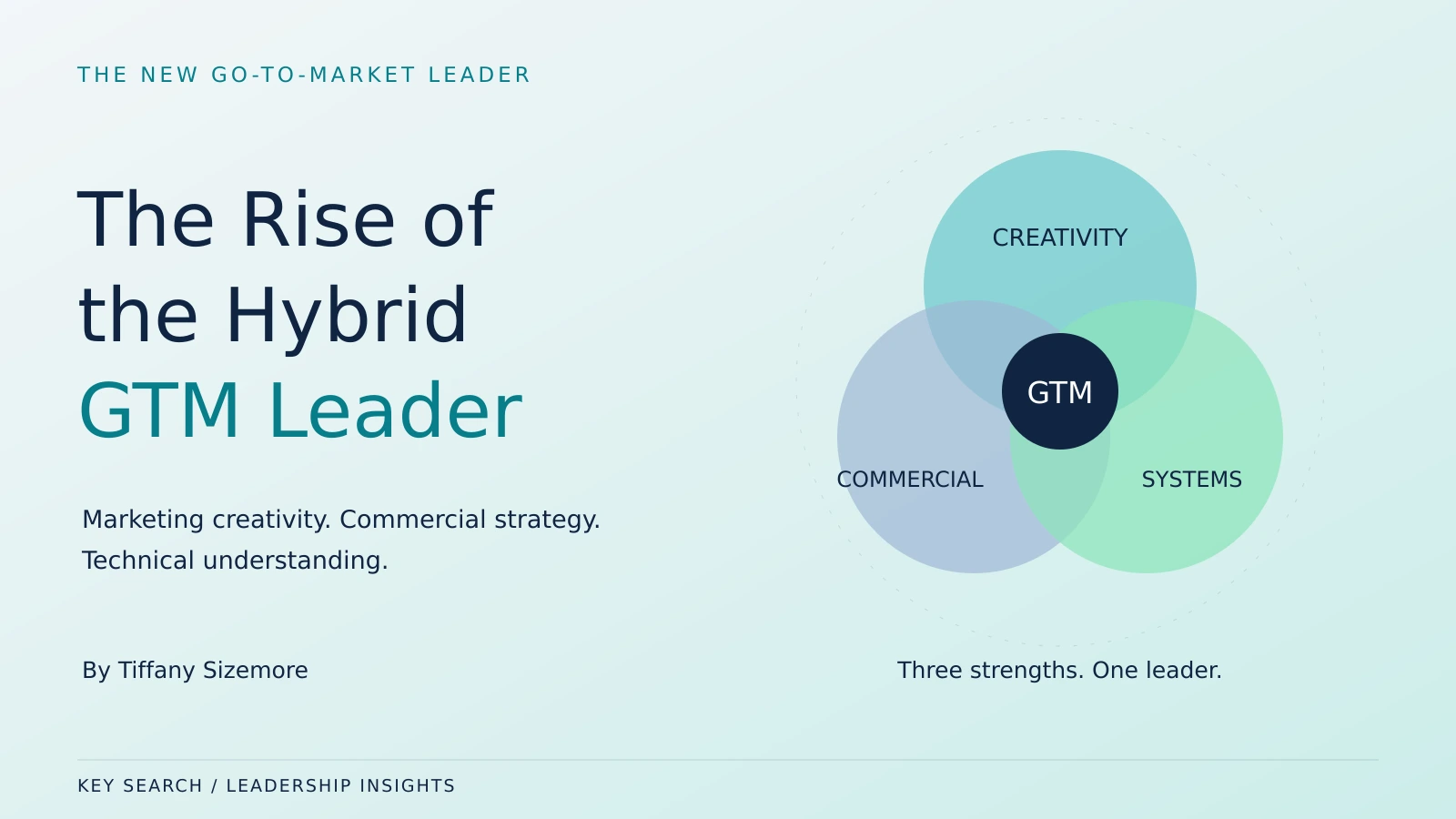
The Rise of the Hybrid GTM Leader
Tiffany Sizemore on the new go-to-market leader blending marketing creativity, commercial strategy and technical understanding to drive predictable growth.

Bleeding Edge vs. Cutting Edge: Why MedTech Investors Are Ditching "Code Moats" for Team Velocity
As AI erodes traditional software moats, MedTech investors are prioritizing talent density, workflow integration, and leadership execution.