
One Year After Brussels: What the Data Says About Women, Capital and Who Gets Hired
A year ago in Brussels, the gender investment gap was laid out in numbers. Here is what changed, what did not, and what it means for every leadership hire.
By Eugenia Alvarez, Partner, Head of Brand & Experience at Key Search
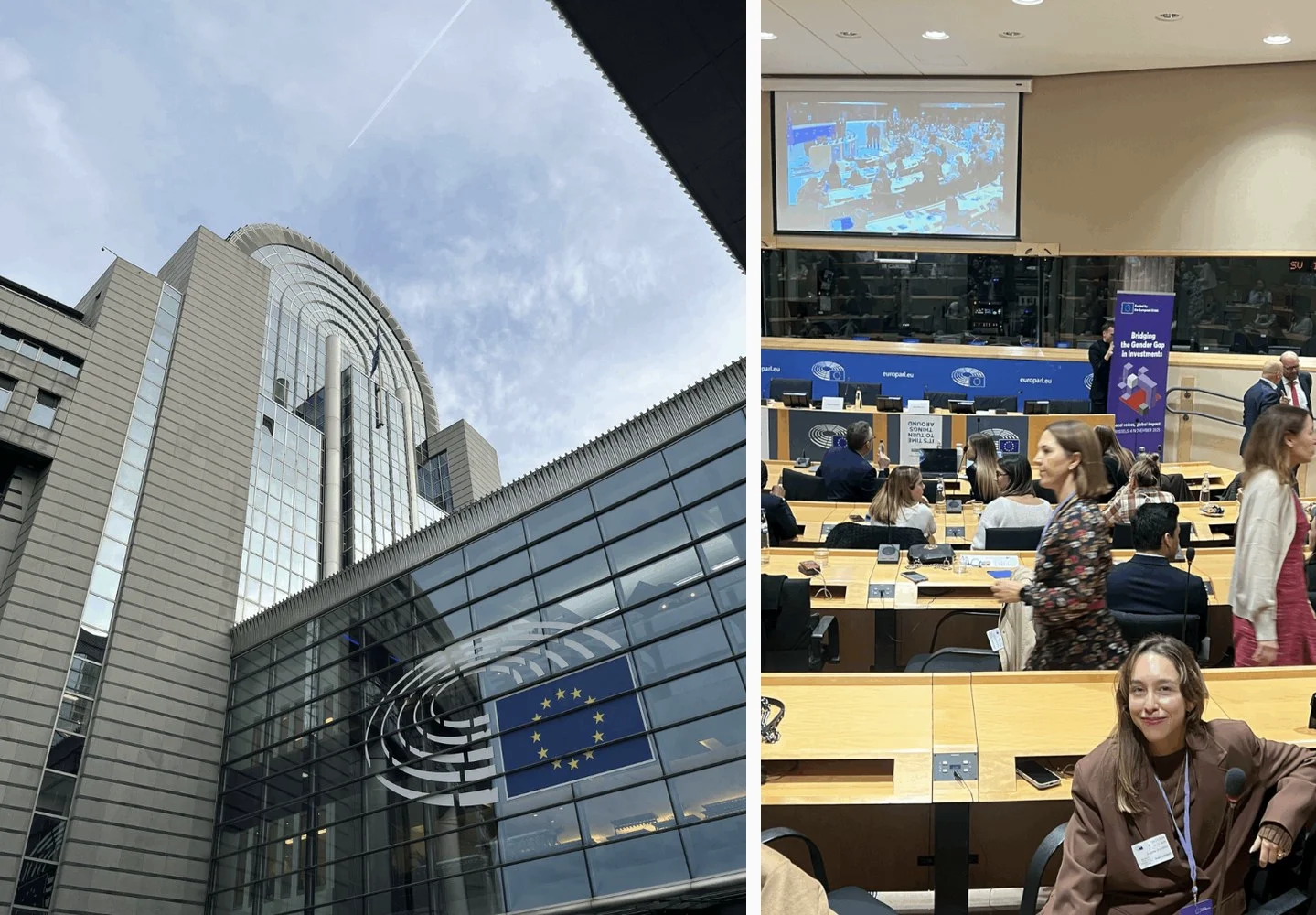
Serendipity is a word we love at Key Search. I felt it strongly on 4 November 2025 in Brussels, when the European Parliament invited me to the launch of the Gender Investment Gap report, an initiative led by MEP Lina Gálvez.
The room was full of policymakers, investors and founders, all focused on one question: why does Europe keep overlooking the talent of half its population when it comes to capital?
I left with three takeaways:
- What we need is clear: access to investment capital, and a seat where investment decisions are made.
- What struck me most: less than 3% of venture capital in Europe goes to all-women founding teams.
- The reflection I took home: women hire women.
One year later, I went back to the data. Some things moved. Some did not. And one of them matters directly to every company hiring a senior leader.
1. Access to capital: the gap did not close, it widened
The Brussels report put the baseline on the table. Women-led startups secured 12% of total VC funding in the EU and 14.4% of rounds. Only about one in five tech companies founded in Europe between 2020 and 2025 had at least one woman founder (19.3% on average). 12
So what happened in the twelve months after?
The headline number went down
According to PitchBook, European female-founded companies raised €9.5 billion in 2025, more than 15% less than in 2024 and the fourth consecutive annual decline. Their share of European deal value slipped to 16.5%, down from 20.4% the year before, while funding for all-male-founded companies grew. 3
The "less than 3%" became closer to 1%
The figure that struck me in Brussels has not improved. All-female founding teams captured 1.3% of European deal value in 2025, and around 1% so far in 2026. Mixed teams moved slightly, from 15% to 16.3%. 4
A more hopeful reading exists, and it matters
Data providers measure this differently. Dealroom, which counts startups with at least one female co-founder, reports €7.5 billion raised in 2025 and a record 13% share of European VC, plus five new women-founded unicorns. 5 And 2026 is tracking better: PitchBook's dashboard showed €9.7 billion raised by September, nearly matching all of 2025. 4
My reading: more money is reaching some women founders, but it is concentrating in fewer, larger rounds. The base of the pyramid, the all-women teams starting out, is still not getting through the door.
The transatlantic contrast
In the US, female-founded startups raised a record $73.6 billion in 2025, an all-time high of 27.7% of US deal value, although roughly two thirds of it went into AI and a handful of megadeals drove the total. 6 Europe is not just behind on volume. It is behind on share, and moving in the opposite direction.
2. Participation in investment decisions: more women at the table, not yet more power
The second need from Brussels was participation in investment decisions. Here, there is real progress.
But the Brussels report also showed the limit of headcount alone: women are 16% of General Partners in venture and growth funds, yet they manage only around 9% of assets. 1 And PitchBook's 2025 analysis is blunt: more women writing checks has not yet translated into more capital for female-led businesses. 3
Why does this matter? Because the pattern is consistent: funds led by women GPs are up to three times more likely to invest in startups with at least one female founder. 7 Seats are not enough. The seats need budgets, and the budgets need to be big enough to shape the market.
One public signal stands out. Women-led companies funded by the European Innovation Council rose from 8% in 2020 to 30% in 2024. 1 When an institution decides to change who it funds, the numbers change fast.
3. Women hire women: why this is a leadership and hiring story
The reflection I carried home from Brussels is the one closest to our work at Key Search.
The evidence is consistent across markets:
- In a study of German and French startups by the Technical University of Munich, all-female founding teams had 62% female employees, versus 35% at startups founded by all-male teams. 9
- In the US, startups with at least one female founder had 38% women in executive roles, 2.4 times the average of startups with no female founders. 10
This is not a "women only" effect. It is a human one: people hire from their networks and recognise talent that looks familiar. Which means that who sits in the room when a shortlist is built shapes the next generation of leaders.
The same logic is playing out at board level, with a deadline attached. The EU Women on Boards Directive required large listed companies to reach 40% of the underrepresented sex among non-executive directors by 30 June 2026. By October 2025, women held 38.2% of those seats, close to the target. Yet at the very top, women were just over 10% of board chairs and just under 10% of CEOs. 1112
Regulation moved the board seats. It did not move the CEO seat. That one is decided in hiring processes.
What I see from the executive search side
At Key Search, we place leaders for tech companies across Europe and the US. The data above matches what I see in practice: capital, boards and leadership teams are connected. Founders who are funded build teams. Teams produce executives. Executives become board members and investors. Break the chain at the first link, and you feel it at every level for a decade.
Three things any company hiring a senior leader can do now:
- Audit the shortlist, not just the longlist. Diverse longlists are common. Diverse final rounds are not. Track who reaches the last interview, not who entered the process.
- Put women on the decision panel. If "women hire women" is true, then the composition of your interview panel is a lever, not a detail.
- Connect the dots. Europe already has many initiatives, funds and networks. What is missing is the connection between them: investors, founders, operators and search partners talking to each other. That is where serendipity stops being luck and starts being design.
One year later
Brussels felt like a full-circle moment. One year on, the data says the work is far from done: the share of capital going to women in Europe fell, the share of women deciding where capital goes rose, and the CEO seat remains the hardest one to change.
I remain committed to building the connections that close this gap, through our work, our community and every leadership search we run. If you share this mission, as an investor, founder or leader, I would love to talk.
Data index
| # | Data point used | Source | Publisher | Date | Link |
|---|---|---|---|---|---|
| 1 | Women-led startups: 12% of EU VC funding, 14.4% of rounds; women are 16% of GPs managing ~9% of AUM; EIC-funded women-led companies 8% (2020) to 30% (2024) | The Gender Investment Gap, study launch coverage | European Commission / EISMEA, via BusinessNow Malta | Nov 2025 | Read |
| 2 | About 1 in 5 tech companies founded 2020 to 2025 had a woman founder (19.3% EU average) | The Gender Investment Gap report, country analysis | European Commission, via Euronews | Nov 2025 | Read |
| 3 | €9.5bn raised by female-founded companies in 2025, 4th annual decline; share of deal value 16.5% vs 20.4% in 2024; more women investors not yet translating into more capital | Europe's VC gender gap isn't closing, even with more women writing checks | PitchBook | Mar 2026 | Read |
| 4 | All-female teams: 1.3% of deal value (2025), ~1% (2026 YTD); mixed teams 15% to 16.3%; €9.7bn raised by Sept 2026 | European VC female founders dashboard, reported by Moonshot News | PitchBook | Sept 2026 | Read |
| 5 | €7.5bn raised by startups with at least one female co-founder in 2025; record 13% share; 5 new women-founded unicorns | Dealroom research, reported by Startupbusiness | Dealroom | Mar 2026 | Read |
| 6 | US female-founded startups: record $73.6bn in 2025, 27.7% of US deal value; ~2/3 into AI | 2025 US All In: Female Founders in the VC Ecosystem | PitchBook | Mar 2026 | Read |
| 7 | Women hold 20% of decision-making roles in European VC (17% in 2022); female-GP funds up to 3x more likely to back a female founder | Seat at the Table 2025 | European Women in VC with BCG, KPMG and partners | 2025 | Read |
| 8 | UK VC firms with no women investors: 48% (2017) to 21% (2025) | Diversity VC 10-year report | Diversity VC, via Sifted | Apr 2026 | Read |
| 9 | All-female founding teams: 62% female employees vs 35% at all-male-founded startups (Germany and France) | Study on gender inequality in the start-up landscape | Technical University of Munich (TUM) | n.d. | Read |
| 10 | Startups with a female founder: 38% women executives, 2.4x the average | Female founders and diversity study (US, 85 startups) | FundersClub, via Phys.org / LA Times | Jun 2017 | Read |
| 11 | Women: 38.2% of non-executive directors in the EU's largest listed companies (Oct 2025) | Women on Boards Directive policy brief | European Institute for Gender Equality (EIGE) | 2026 | Read |
| 12 | Women: just over 10% of board chairs, just under 10% of CEOs; Directive deadline 30 June 2026 | After a decade of making the conversation: gender balance on corporate boards | EIGE | Jun 2026 | Read |
Note on methodology: PitchBook counts companies with at least one female founder and reports share of deal value; Dealroom uses its own definition of women-founded companies. Figures are not directly comparable across providers, which is why both are shown.
Key Search
Connect with Key Search to discuss your next leadership hire.
This article and its photos were created with the use of A.I. and reviewed by a human Key Search Partner.
Related articles
Sustainable Innovation Needs Leaders Who Can Turn Ambition into Action
Reflections from the IMPACT FESTIVAL in Frankfurt: Leonie Fehr on sustainable innovation, technological transformation and the leadership needed to turn ambition into action.

Investors Are Writing Growth-Stage Checks at Series A
Does the leadership team match the investment? Maren Marcelis explores what larger Series A rounds mean for founders, boards and executive hiring.

Smaller Teams, Bigger Talent Bets: How AI Is Reshaping B2B SaaS Hiring
Konrad Nowicki explores how AI is changing B2B SaaS hiring, why smaller teams raise the stakes for every appointment and what founders should look for in their next leaders.