
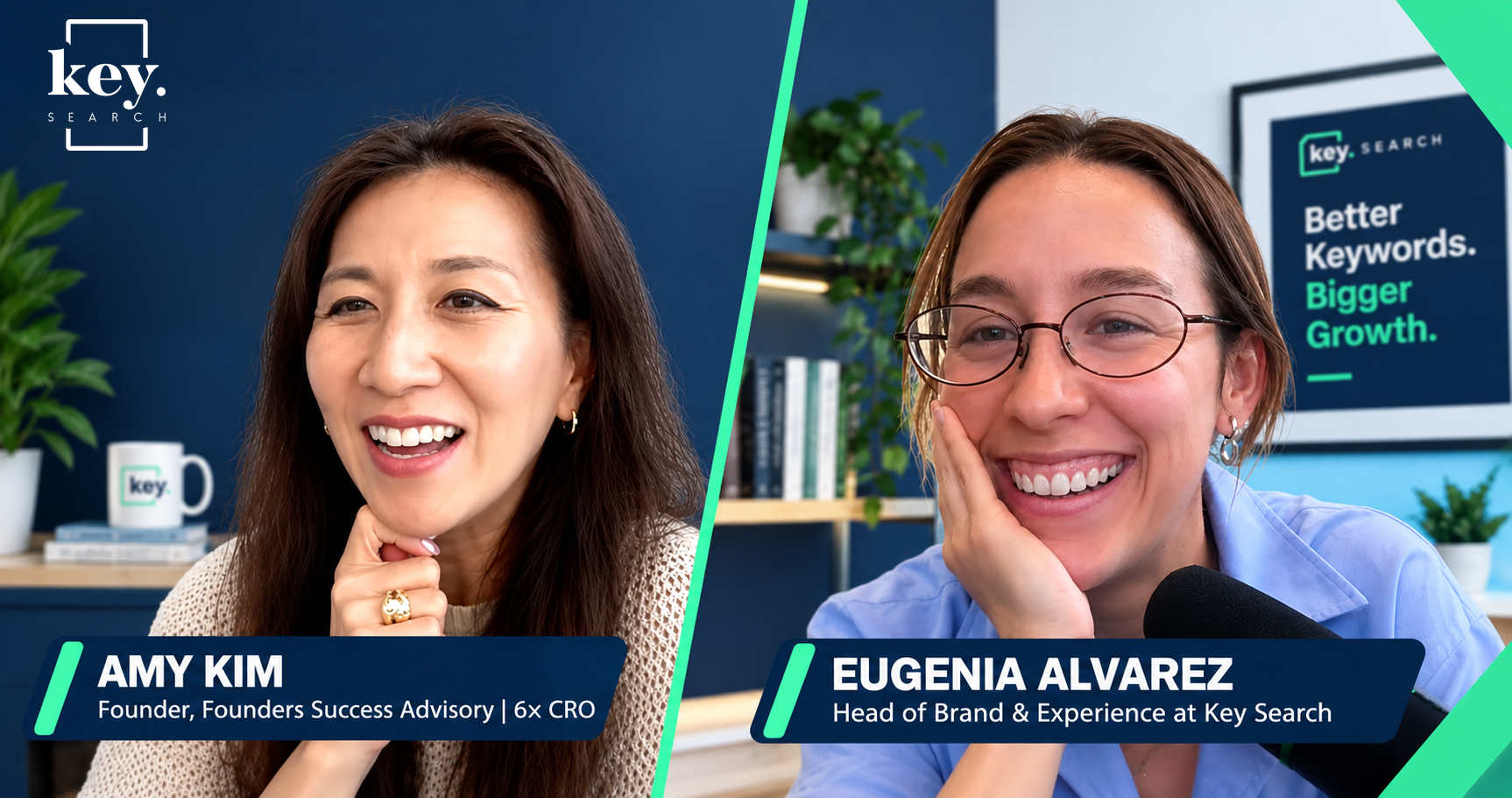
Scaling Revenue in the AI Era: Key Lessons from Amy Kim
What founders can learn from six-time CRO Amy Kim about realistic growth plans, cross-functional hiring and the human leadership behind effective AI adoption.
AI is changing how companies find customers, organize commercial teams and plan for growth. But faster tools do not remove the hardest parts of scaling: choosing the right people, building connected processes and giving those decisions enough time to work.
That was a central lesson from the Leaders Lounge conversation between Eugenia Alvarez from Key Search and Amy Kim, founder of Founders Success Advisory and a member of our Trusted Advisors network. A six-time Chief Revenue Officer across Series A to C startups with experience at Google and Microsoft, Amy brought a practical perspective shaped by successful exits as well as companies that did not scale.
For founders and leadership teams, the conversation offers a useful way to rethink revenue growth, executive hiring and the human side of AI adoption.
1. Start with the outcome, not the technology
Startups and established businesses face different circumstances, but Amy identified a shared challenge: knowing which changes will produce the results they need.
A startup may be able to build a product with a much smaller team than before. An established company may suddenly face competitors with very different cost structures and ways of working. Neither situation makes the right response obvious.
The starting point is not simply to adopt more AI tools. It is to define what needs to improve and then decide which combination of people, processes and technology can deliver that change.
The lesson: make the business outcome clear before choosing the tool. Revenue growth, better quality and faster execution require different decisions and different measures of success.
2. Revenue plans need to account for the full hiring ramp
One of the most practical insights concerned the transition from Series A to Series B. Early validation shows that a product can sell. The next stage brings pressure to make revenue more repeatable, predictable and scalable.
New funding can create a rush to hire. Yet a new commercial leader or salesperson cannot produce results the moment they join. Recruitment, onboarding, training and a complete sales cycle all take time.
Amy described situations where that journey can take nine to twelve months while the funding plan expects meaningful growth in three or six. The point is not that every company follows the same timeline. It is that forecasts need to reflect how the business actually sells.
The lesson: align hiring budgets and revenue expectations with realistic ramp times. Adding headcount is an investment in future capacity, not an immediate guarantee of revenue.

3. Growth and scale are not the same thing
Amy was candid that not all six companies where she held CRO roles scaled successfully. That distinction matters because adding products, salespeople or marketing investment can increase revenue without creating a business that scales effectively.
Scaling depends on whether the systems, processes and people can support a different level of growth. A larger team cannot compensate indefinitely for an unclear model or disconnected operations.
Her related advice was to question the instinct to copy the world's most exceptional companies. An ambitious vision can be valuable without treating an outlier's trajectory as a dependable operating plan.
The lesson: build a model around the company's market, resources and evidence. Pair ambition with practical operational leadership that can turn the vision into execution.
4. Go-to-market leadership is becoming more cross-functional
Traditional commercial structures often separated marketing's work from sales: one function generated awareness and nurtured leads before handing opportunities to the other. Amy described how AI-enabled tools are making those boundaries less distinct.
Identifying potential buyers, reaching them and nurturing relationships increasingly involves connected data and workflows. The opportunity is not simply to automate each department independently. It is to rethink how the full customer journey works.
This changes what companies should look for in a go-to-market hire. Deep sales, marketing or engineering expertise can be valuable, but the ability to work across those functions becomes essential when someone is expected to design the wider system.
The lesson: assess candidates for cross-functional judgment as well as functional expertise. Understand how they connect customer insight, commercial goals, data and systems.
5. Hire someone who can design the workflow before buying the system
For an early-stage founder choosing between a go-to-market hire and a go-to-market system, Amy's priority was the person. The reasoning was straightforward: someone needs to understand the funnel, architect the workflow and decide which data streams the system should use.
That person needs to be comfortable with systems and data, not only with a particular application. As platforms become more connected, coherent data and clear workflows matter at least as much as the interface a team uses.
Amy also cautioned against searching for an impossibly experienced specialist in a role that is still emerging. A new title does not come with a long-established pool of candidates who have already done precisely the same job for years.
The lesson: prioritize relevant experience, learning ability and evidence of working across teams. Define the problem to solve rather than relying on a fashionable job title.
6. Experienced leaders remain essential when AI takes on more work
AI can perform more tasks, but people still determine what those tasks should achieve. Amy emphasized that experienced leaders design the process, set expectations and recognize whether an apparent efficiency gain is producing a useful business result.
That judgment becomes especially important when teams are experimenting with agents and connected tools. Someone needs to assess quality, redirect the workflow and decide where human intervention is necessary.
Eugenia also highlighted the human side of that responsibility. Employees may experience AI adoption as uncertainty about their jobs or the value of their skills. Leaders need to explain the change and help people navigate it.
The lesson: look for leaders who can combine commercial judgment with clear communication and practical support for their teams.
7. Give people a clear plan for the time AI saves
Telling a team to use AI is not the same as helping it work differently. Amy's point was that leaders need to understand how the tools can change a process and guide people through that redesign.
If a task takes much less time, the next question is what valuable work should fill the space. Without that decision, an efficiency gain may not translate into a meaningful improvement for the company or its customers.
There may still be legitimate questions about unnecessary tasks or duplicated work. But Amy's emphasis was on helping the same people create more valuable output rather than treating every saving as a headcount reduction.
The lesson: make AI adoption a workflow and leadership project, not simply a software rollout. Define the higher-value work that becomes possible.
8. Practical experimentation builds confidence and opportunity
Amy described using different AI tools for different needs, including Claude for work, ChatGPT for creative tasks and Gemini for general questions. The broader point was not to endorse one tool as the answer to every problem. It was to build familiarity through use.
For people concerned about how AI will affect their careers, practical learning can be more useful than waiting for certainty. Testing a relevant use case helps develop judgment about where the technology is useful and where it falls short.
That message also shaped the discussion about women in technology. Amy did not claim that AI has already resolved barriers to participation. Instead, she encouraged women to experiment and apply the technology to areas that interest them, including functions beyond engineering.
The lesson: create opportunities to learn through real work. AI skills are not limited to coding and access to those skills should not be limited to one part of the organization.
9. Supporting women in leadership requires practical action
Drawing on her experience of being the only woman in leadership settings, Amy emphasized the value of knowing your field, communicating your perspective and holding your position thoughtfully.
She also described supporting other women as her own career developed. That support went beyond general encouragement to helping people learn new functions, navigate organizations and build the skills needed for greater responsibility.
The connection to leadership hiring is clear: developing a stronger pipeline requires more than recognizing potential. People also need access to experience, relationships and opportunities to demonstrate what they can do.
The lesson: make career support specific. Help people gain relevant skills and responsibilities rather than leaving development at the level of advice.
Before the next hire, identify the gap
Amy's closing advice brought the conversation back to a simple discipline: assess the go-to-market process before rushing to recruit. What is working? What is missing? Why is another hire the right response?
For founders and leadership teams, that suggests a practical preparation checklist:
- Define the outcome: be specific about the business result the role needs to deliver.
- Map the process: understand the customer journey and where the current approach breaks down.
- Check the foundations: assess whether the data, systems and team responsibilities support the plan.
- Set a credible timeline: allow for recruitment, onboarding and the sales cycle.
- Match experience to the gap: look for the right judgment and capabilities rather than a title alone.
AI may change the tools and the pace of work, but sustainable growth still depends on clear priorities and leaders who can translate them into action.
Continue learning with the Key Search network
Connect with Amy Kim on LinkedIn or explore Founders Success Advisory. Amy works with businesses at different stages, from early market definition to executive team building and the modernization of established workflows.
For more perspectives, explore our Trusted Advisors network or contact the Key Search team to discuss your leadership hiring needs.
This article draws on Amy Kim's Leaders Lounge conversation with Eugenia Alvarez. The lessons and checklist are an editorial synthesis of the discussion, not a verbatim transcript.
Key Search
Key Search specializes in expansion hires across Europe, the US, and transatlantic searches. To find out more about our US and North American hiring capability, visit us below.
This article and its photos were created with the use of A.I. and reviewed by a human Key Search Partner.
Related articles

Hiring Women in VC Isn't a Shortlist Problem
What funds across DACH and the UK get wrong after the appointment
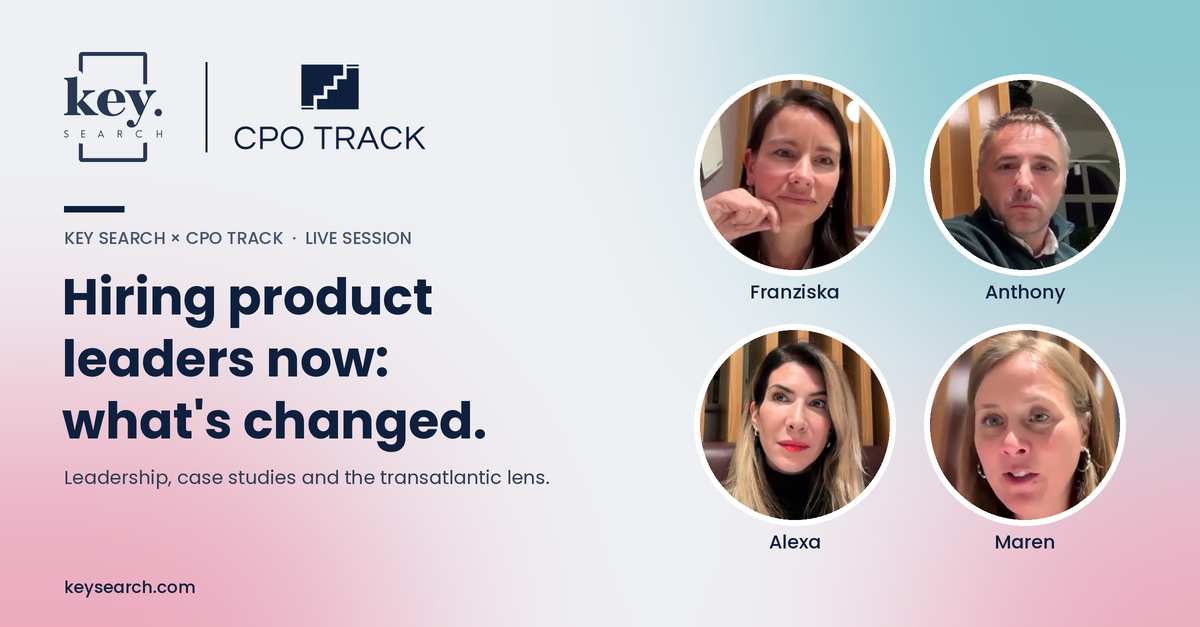
Beyond the Roadmap: CPO Career Insights from Key Search Partners
What helps a product leader stand out? Lessons from a CPO Track community conversation with Key Search partners on player-coach leadership, credible evidence and career progression.

The Myth of the “Only One”: Why Women Supporting Women Matters in Executive Leadership
The idea that women do not support women overlooks a bigger issue: systems that leave room for only one. Franziska Palumbo-Seidel explores sponsorship, executive search and a broader vision for female leadership.