
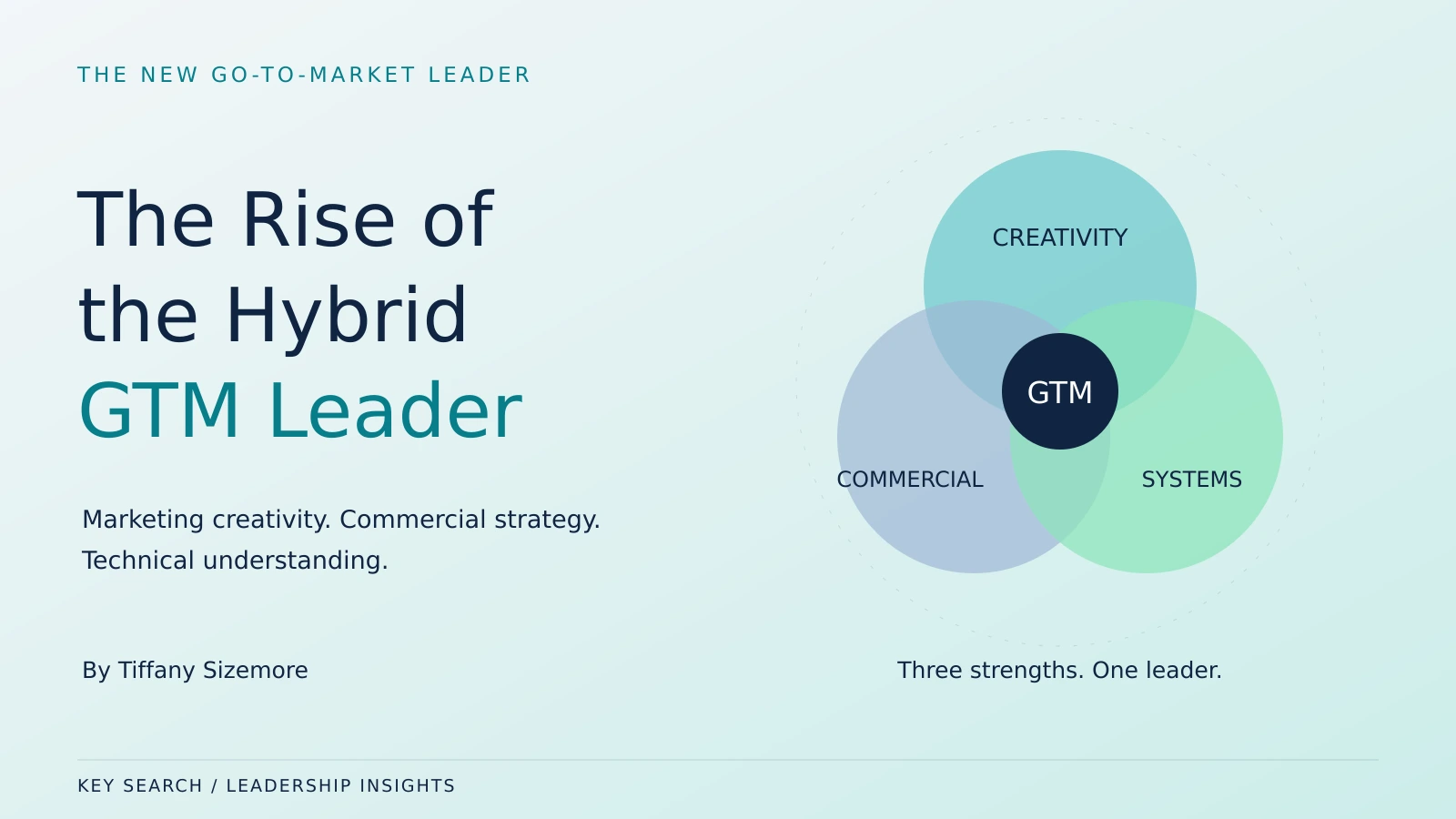
The Rise of the Hybrid GTM Leader
Tiffany Sizemore on the new go-to-market leader blending marketing creativity, commercial strategy and technical understanding to drive predictable growth.
In so many of my recent conversations with US founders, boards and PE operating partners, across SaaS, marketplace, eCommerce and consumer businesses, one theme keeps coming up: the marketing leader that worked brilliantly a few years ago may not be quite what the business needs today.
Brand and creative still matter enormously. What's changed is that boards would now love to see a clearer line from marketing investment to revenue. That's shaping a new kind of go-to-market (GTM) leader, one who blends marketing, commercial strategy and technical know-how. I wanted to share what I'm seeing, what this leader tends to look like, and a few thoughts on finding one.
What US growth looks like right now
The picture varies quite a bit by business model, which is part of what makes GTM leadership so interesting at the moment.
SaaS growth is becoming more efficient. Median growth across private B2B SaaS companies is around 22%, down a little from 25% in 2024, with equity-backed companies holding steady at 25% (SaaS Capital). Interestingly, the companies with the strongest net revenue retention grow the fastest, a lovely reminder that expansion and retention matter just as much as new logos.
US eCommerce and consumer are picking up. Online sales reached $340.2 billion in Q2 2026, up 12.2% year over year and roughly twice the pace of total retail, and now make up about 17% of all US retail spending (Practical Ecommerce, citing Census Bureau data). For marketplaces and consumer brands, that's real opportunity, alongside real competition for attention.
Capital is flowing in from VC and PE. US startups raised about $91 billion in Q3, around 57% of global venture funding (Crunchbase). On the PE side, US sponsors completed 2,467 deals worth $233.8 billion, with add-ons making up nearly three-quarters of buyouts (CLA, citing PitchBook). For PE-backed SaaS and eCommerce businesses, that often means a GTM leader who can bring several teams together during a defined hold period.
Across all of these, the common thread is a leader who can help turn investment into steady, predictable growth and share that story clearly with the board.
Bringing the GTM engine together
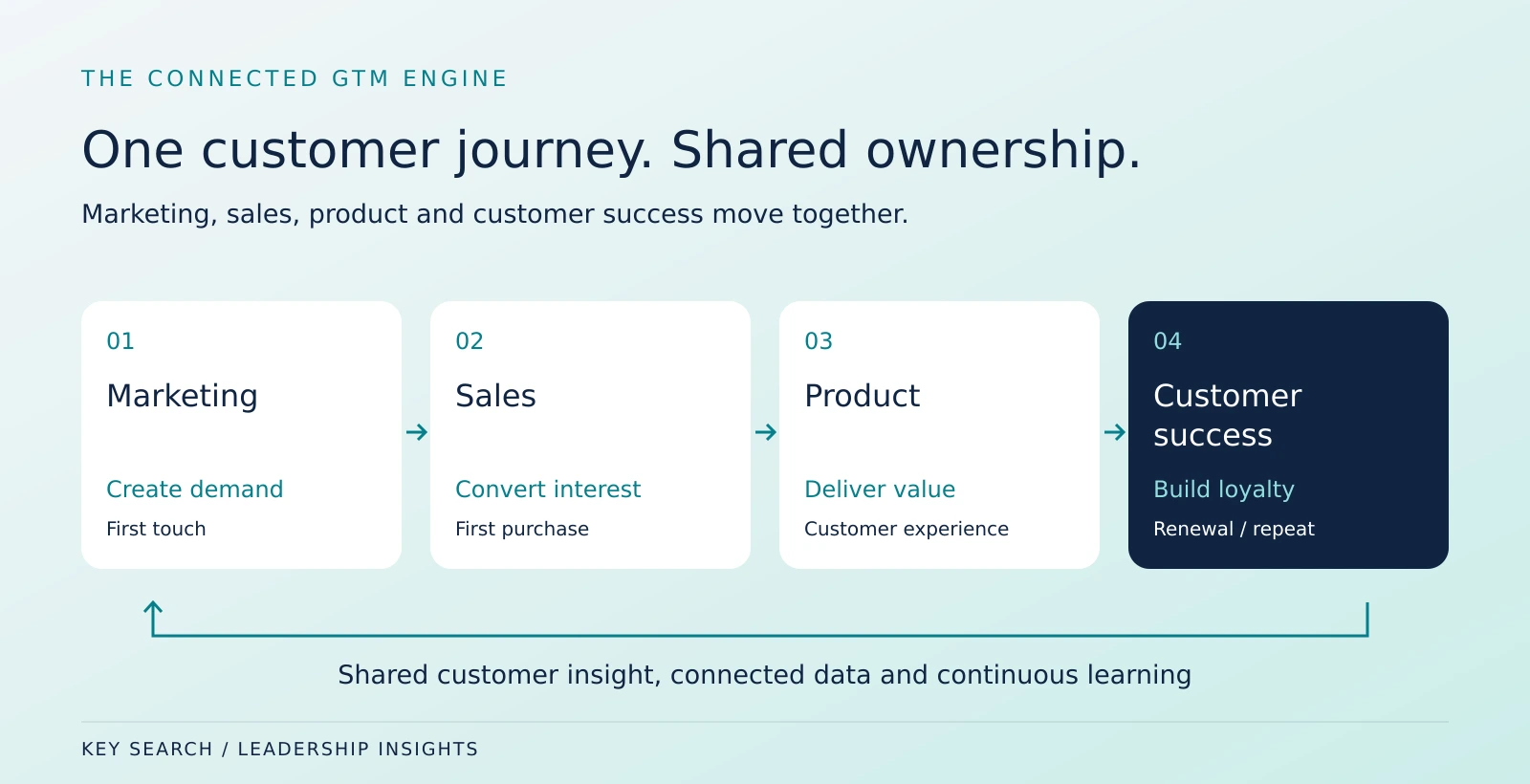
The customer journey rarely follows a neat handoff from marketing to sales anymore. It weaves through marketing, sales, product and customer success, and it works best when those teams move together.
The companies I see doing this well treat the funnel as one connected system, from first touch to renewal in SaaS, or first purchase to repeat order in eCommerce and consumer. That calls for a leader who understands each stage, works closely with the CRO and CPO, and enjoys sharing ownership of the number.
Commercial acumen
Board conversations increasingly center on metrics like CAC, LTV, pipeline contribution, sales velocity and net revenue retention. Marketplaces often add liquidity and take rate, while eCommerce and consumer brands look closely at repeat purchase rate and contribution margin. In PE-backed businesses, EBITDA impact is usually part of the conversation too.
The GTM leaders who really shine tend to think like general managers. They start with the revenue goal and work backward, focusing on the most valuable customer segments and building a thoughtful, efficient motion to reach them. Over time, that helps marketing become a trusted growth engine for the business.
Comfort with technology and data
This isn't about writing code. It's more about understanding how the pieces fit together: how CRM, marketing automation, analytics and customer data platforms connect, and how to keep the data flowing cleanly between them.
That foundation makes personalization, lead scoring and attribution so much easier. The leaders who partner comfortably with the CTO tend to build the strongest GTM engines.
AI as part of how great leaders build
AI has quickly become one of the biggest forces shaping how companies grow. AI-driven startups attracted about 64% of global venture capital in Q3 (Crunchbase), and nearly every SaaS, marketplace, eCommerce and consumer business I speak with is exploring how it can help them move faster.
For GTM leaders, this is such an exciting opportunity. The ones making the biggest impact aren't treating AI as a side project. They're weaving it into how they build: sharper segmentation and personalization, faster content and campaign testing, smarter forecasting, and leaner teams that can accomplish far more. Just as importantly, they bring their teams along, helping people learn new tools with confidence rather than worry.
Boards and investors notice this. A leader who can thoughtfully show how AI is improving pipeline, conversion or efficiency, rather than just experimenting with it, is in a wonderful position to make a lasting difference.
Three strengths in one leader
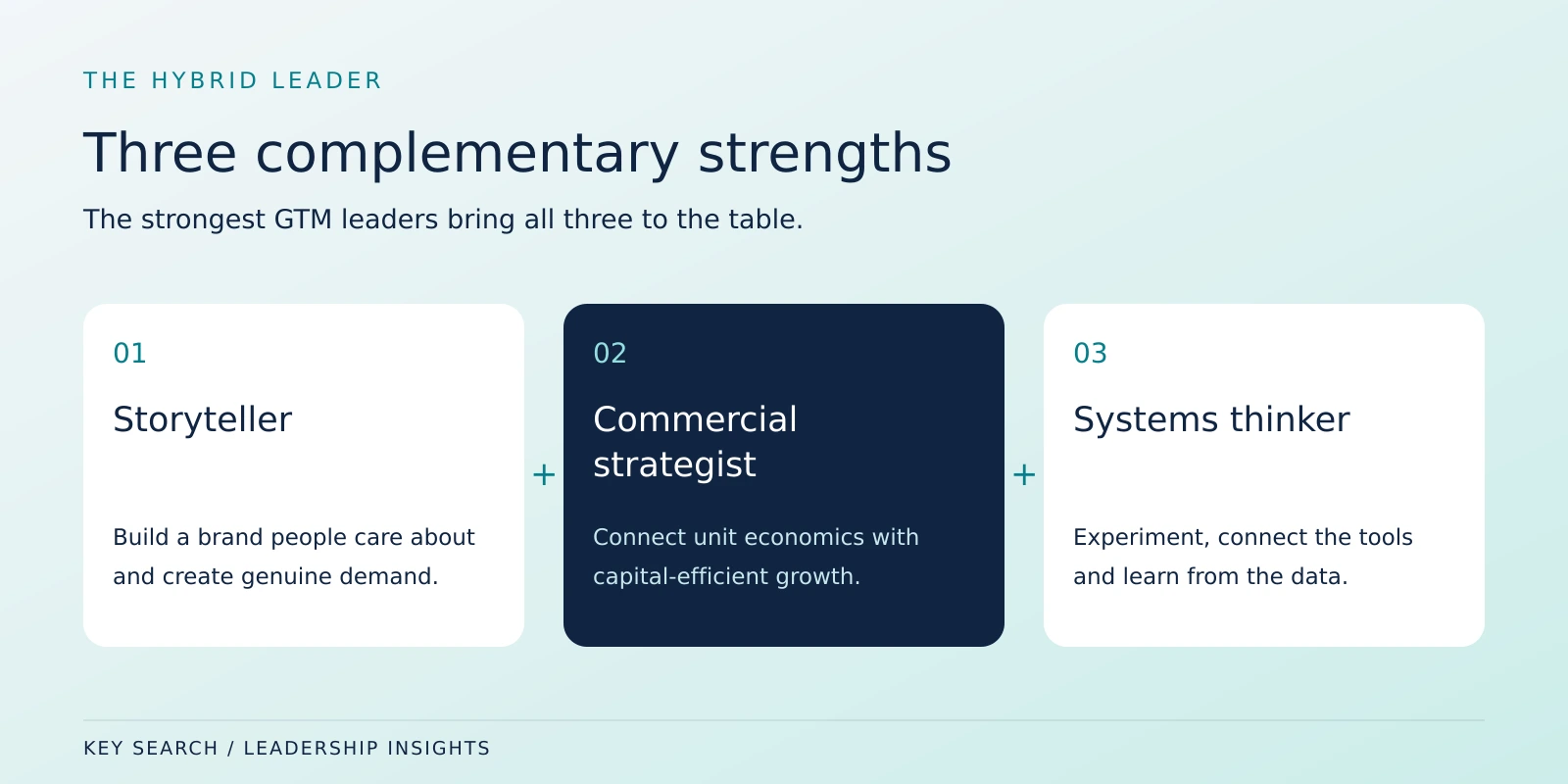
The leaders I see thriving often bring together three strengths:
- A storyteller who builds a brand people care about and creates genuine demand.
- A commercial strategist who thinks carefully about unit economics and the most capital-efficient path to the next $10 million in ARR.
- A systems thinker who is curious, experimental and guided by data at every stage of the funnel.
It's a rare combination. These leaders often come from a mix of marketing, RevOps, sales operations or product, and many have owned a revenue number along the way.
Finding the right person
A strong creative portfolio is a great start, but a few thoughtful questions can tell you even more:
- Commercial: "Could you walk me through how you built your last marketing budget and connected it to revenue and CAC goals?"
- Technical: "Tell me about a time you rebuilt or improved your MarTech stack. What were you solving for, and where has AI made the biggest difference for your team?"
- Strategic: "How would you approach your first 90 days getting to know our GTM engine?"
- For PE-backed roles: "Have you brought GTM teams together after an acquisition? What did you learn?"
It also helps to look for experience in a model like yours, whether SaaS, marketplace, eCommerce or consumer, along with close partnerships with sales and finance and, ideally, some P&L or RevOps ownership. The best candidates I meet tend to talk like curious scientists as much as storytellers.
Looking ahead
This shift feels less like a passing trend and more like where GTM leadership is heading. Whether you're a VC-backed US scaleup in SaaS, marketplace, eCommerce or consumer, or a PE-backed business working toward a value-creation plan, having a marketing leader closely connected to revenue makes a real difference.
It might be a good moment to reflect on whether your GTM leadership is set up for the market we're in today.
Helping companies find leaders who bring together commercial strategy, technical depth and marketing creativity is something we genuinely love doing at Key Search. If you're thinking about your next GTM hire, I'd be so happy to chat.
Sources
Key Search
Key Search specializes in expansion hires across Europe, the US, and transatlantic searches. To find out more about our US and North American hiring capability, visit us below.
This article and its photos were created with the use of A.I. and reviewed by a human Key Search Partner.
Related articles
Scaling Revenue in the AI Era: Key Lessons from Amy Kim
What founders can learn from six-time CRO Amy Kim about realistic growth plans, cross-functional hiring and the human leadership behind effective AI adoption.

Hiring Women in VC Isn't a Shortlist Problem
What funds across DACH and the UK get wrong after the appointment
Beyond the Roadmap: CPO Career Insights from Key Search Partners
What helps a product leader stand out? Lessons from a CPO Track community conversation with Key Search partners on player-coach leadership, credible evidence and career progression.