
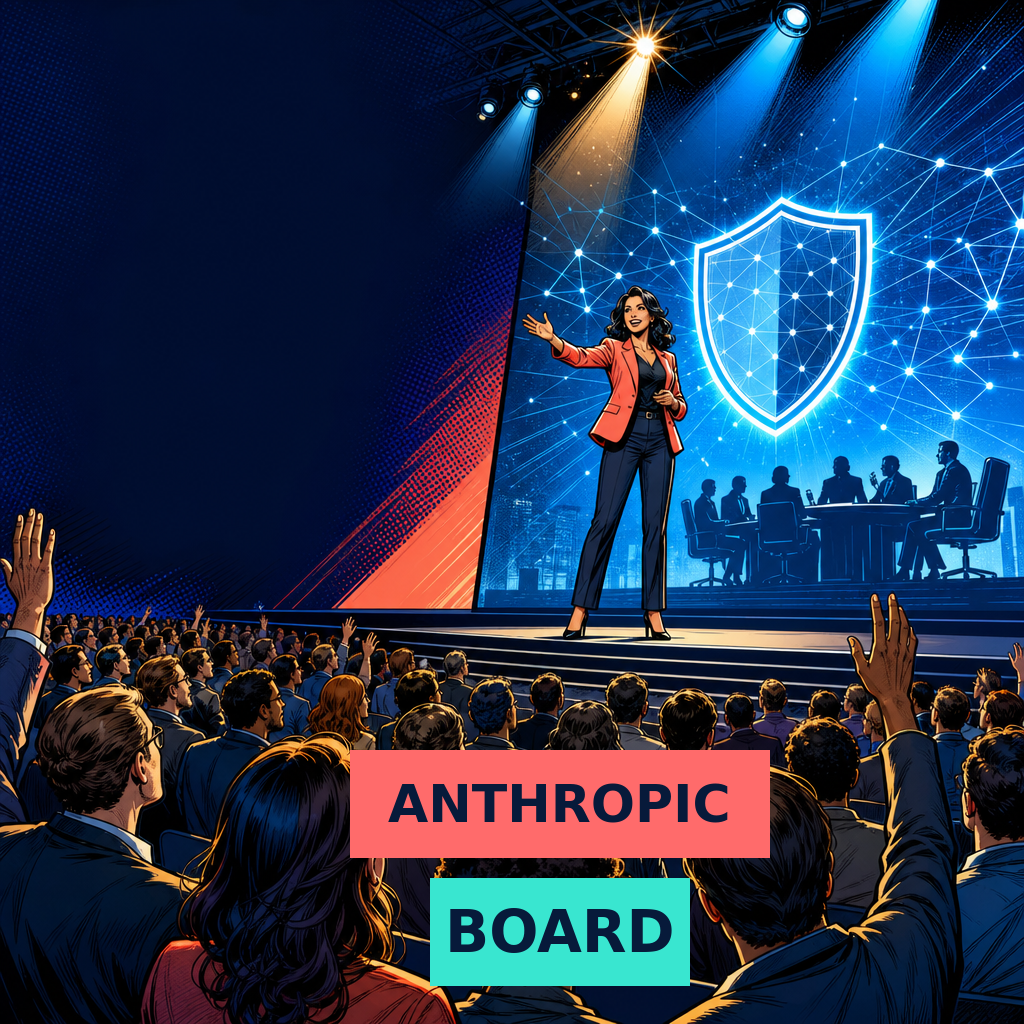
Why Every Modern Board Needs an AI Oversight Blueprint
As AI advances faster than regulation, modern boards need independent oversight frameworks that can make swift, binding decisions.
Anthropic CEO Dario Amodei recently underscored this question in a public call for tech companies to address the existential risks of advanced AI. He framed the solution around a two-pronged response: government legislation and industry self-governance. But as Amodei famously noted, taking AI risks to regulators is like talking to Treebeard from The Lord of the Rings, an ancient creature who takes a full day just to say hello. The mismatch in speed is structural. By the time legislators draft rules for one generation of AI, the industry has already deployed the next.
While Anthropic has actively positioned itself as the "ethical" alternative in the AI arms race, self-governance cannot remain a marketing campaign. To build long-term enterprise value and protect public trust, C-suites and boards must move beyond voluntary internal guidelines and look to proven frameworks of independent oversight, specifically, the lessons learned from social media’s platform governance crises.
The Speed Gap: Why Regulation Isn't Enough for Frontier AI
Legislation sets essential baseline rules and enforcement mechanisms, but relying solely on public policy leaves a dangerous exposure gap. Technology moves exponentially; legislation moves linearly.
When private entities hold immense power over systems that can impact critical infrastructure, cybersecurity and societal stability, waiting for regulatory clarity is a failure of risk management. Boards and executive teams must establish independent, nimble institutions capable of making swift, binding decisions in real time.
The Three Non-Negotiable Pillars of Effective AI Oversight
Drawing from the largest experiment in independent platform governance, Meta’s Oversight Board, effective oversight for frontier technology requires three structural components:
Independent and Representative Overseers: The oversight body must hold decisional independence, the power to issue binding mandates, and financial independence, revocable-proof funding structures. Members must serve fixed, staggered terms, control their own membership and represent diverse global perspectives rather than a homogenous Silicon Valley echo chamber.
External, Immutable Standards: Governance cannot rely on internal policies that the executive team can rewrite out of quarterly convenience. Oversight must anchor itself in external, recognized standards, such as international human rights frameworks or irrevocable constitutional pre-commitments.
Radical Transparency ("Open-Source Governance"): Substantive decisions, rationale and corporate responses must be published publicly. Transparency creates precedent, invites external critique and proves to shareholders and the public that the institution has avoided regulatory capture.
Why Current AI Self-Governance Still Falls Short
To their credit, several AI leaders have attempted novel governance structures. Anthropic created its "Long-Term Benefit Trust" to align decisions with its mission, adopted a public benefit corporate form and published a safety "constitution" for its Claude models.
However, when examined through a rigorous governance lens, critical vulnerabilities remain:
Opacity: Trust governing agreements often remain non-public, leaving investors and stakeholders blind to actual decision-making dynamics.
Short Tenures & Weak Enforcement: Trustees serving brief, one-year terms with unclear shareholder override powers lack true independence. Furthermore, corporate AI "constitutions" often lack formal enforcement mechanisms or user rights protections.
Advisory vs. Binding Distinctions: Without an independent body capable of issuing binding take-down, pause, or architectural modification directives, "ethical guidelines" remain purely advisory.
By contrast, Meta’s Oversight Board has issued over 200 binding directives and 300+ public recommendations, with roughly 75% adopted whole or in part by Meta. While content moderation differs from AI architecture, the core challenge remains identical: constraining private power exercising immense public influence.
What This Means for C-Suite Leadership and Board Recruitment
For enterprise executives, board members and investors, AI governance is no longer just a technical or legal sub-field, it is a core leadership competency.
Building a resilient organization in the age of frontier AI requires rethinking how you hire and structure your leadership team:
Rethink the Board Profile: Boards need directors who understand tech governance, ethical risk frameworks and systemic risk mitigation, rather than traditional industry operators alone.
Assess "Coachability" and Transparency in AI Executives: Hiring a Chief AI Officer (CAIO) or Chief Technology Officer requires evaluating their willingness to submit to external accountability and independent oversight.
Separate Execution from Oversight: Just as financial auditing requires independent oversight, AI safety and alignment cannot sit entirely under the revenue-driving arm of the organization.
Conclusion: Securing the Future Before Disaster Strikes
For enterprises deploying advanced AI models, establishing genuine, transparent and binding oversight is the ultimate test of leadership maturity.
Building a future-proof organization starts with securing the right leadership team. Contact me today to discuss how our strategic executive search methodology can connect your organization with visionary board members and C-suite leaders.
Key Search
Key Search specializes in expansion hires across Europe, the US, and transatlantic searches. To find out more about our US and North American hiring capability, visit us below.
This article and its photos were created with the use of A.I. and reviewed by a human Key Search Partner.
Related articles

The Enterprise AI Margin Trap: Why B2B SaaS Needs Commercial Architects, Not Model Engineers
The real battleground for enterprise AI platforms centers on three frontline operational realities: overcoming procurement resistance to new billing models, guaranteeing agentic SLAs, and surviving the structural collapse of gross margins. POC demos and bloated compute bills are past history—today’s challenge is purely commercial and operational.

Europe's E-commerce Growth Is a Marketing Leadership Test
European e-commerce is growing, but winning customers is getting harder. Leonie Fehr explains why marketing leadership matters more than ever and what companies should look for when hiring.

Bleeding Edge vs. Cutting Edge: Why MedTech Investors Are Ditching "Code Moats" for Team Velocity
As AI erodes traditional software moats, MedTech investors are prioritizing talent density, workflow integration, and leadership execution.