
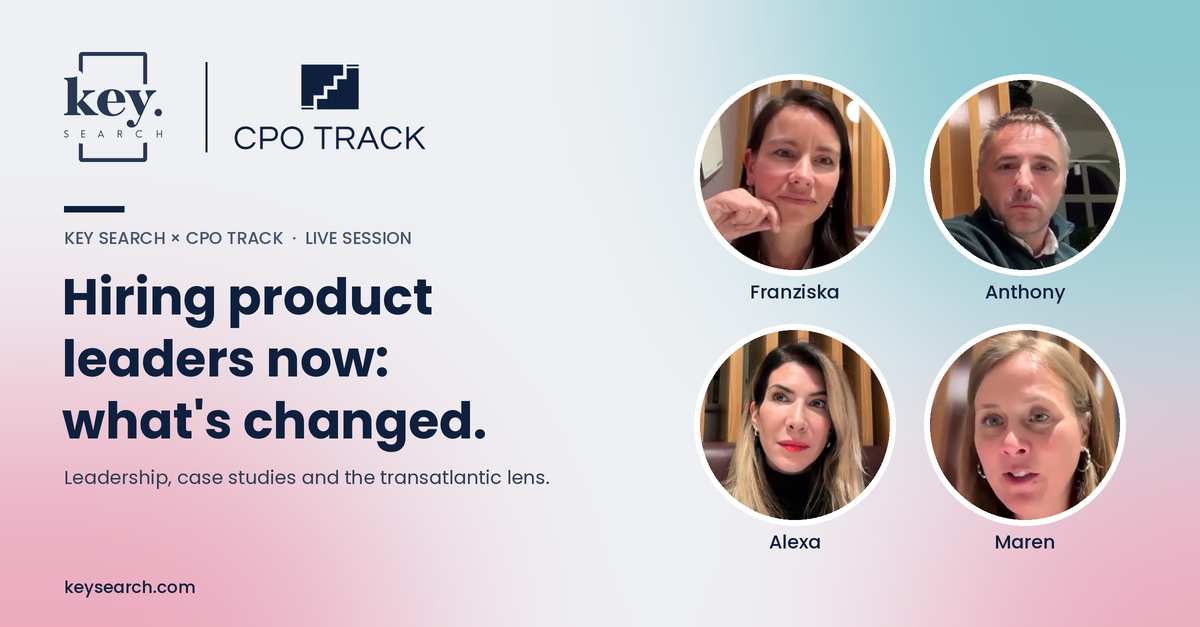
Beyond the Roadmap: CPO Career Insights from Key Search Partners
What helps a product leader stand out? Lessons from a CPO Track community conversation with Key Search partners on player-coach leadership, credible evidence and career progression.
What makes a product leader stand out when AI is changing how products are built and companies are rethinking what they need from their leadership teams?
That question connected many of the contributions in a CPO Track community conversation with Key Search partners Franziska Palumbo-Seidel, Anthony Little and Maren Marcelis. Participants asked about executive positioning, practical assessment, founder experience and the changing expectations of product leadership.
The partners’ written contributions offer useful starting points: early-stage companies value player-coaches, candidates are finding new ways to demonstrate their work, a CPO role can lead toward the CEO seat and professional relationships matter beyond an active search.
Here are the takeaways for product leaders and the people hiring them, drawing on those recorded comments and the questions they prompted.
Watch the conversation highlights
 ▶
Leadership is back: what we're seeing in executive searchWatch on YouTube ↗ (new tab)
 ▶
How to make your executive case study memorableWatch on YouTube ↗ (new tab)
 ▶
Features don't get you hired. Impact does.Watch on YouTube ↗ (new tab)
 ▶
Be authentic. Search firms will see through it.Watch on YouTube ↗ (new tab)
1. Match your leadership style to the company’s stage
One of the clearest partner observations came from Franziska and Anthony: “Series A Companies like "Player Coaches"”.
For a product leader, the practical implication is that setting direction may not be enough. In an early-stage business, the role can also require getting close to customer discovery, working through prioritization with engineers and helping a small team make decisions before the operating structure is fully established.
That does not mean doing everyone’s job. It means showing that you can move between strategic judgment and practical contribution without becoming a bottleneck.
For your next conversation: prepare an example of when you personally helped resolve a difficult product problem and another of when you built a team’s ability to solve it without you. Ask the founder where they need you to be hands-on and what they expect you to delegate.
For hiring teams: define what “player-coach” means in your business. A title is not a substitute for agreement about responsibilities, resources and decision-making authority.
2. Make your work visible, but make the evidence count
Franziska and Anthony noted that candidates increasingly have their own vibe-coded websites. The observation points to an accessible way for product leaders to make their thinking tangible through a personal site, prototype or portfolio.
However, visibility and credibility are not the same thing. An audience member who was hiring cautioned that an unpolished, irrelevant example could work against a candidate. That was a participant’s perspective, not a stated Key Search hiring policy, but it raises an important question: what does your work sample actually demonstrate?
A useful portfolio helps someone understand a customer problem, the choices you considered, the trade-offs you made and what you learned. A polished interface alone cannot explain your leadership contribution.
For your next conversation: choose one example that is relevant to the company’s challenge. Explain your own contribution, distinguish shipped results from a prototype and use only information you are authorized to share.
3. Explain your impact, not just your roadmap
The audience returned repeatedly to value: how product leaders communicate their contribution, which outcomes matter and what boards expect as AI reshapes product work. One participant summarized the principle as selling value and impact rather than features and roadmaps.
The written chat does not capture the partners’ full answers to those questions. A practical takeaway for CPOs is nevertheless clear: your career narrative should help a founder or board understand the business decisions behind your product work.
Instead of listing launches, explain the problem you prioritized, why it mattered commercially, what you chose not to build and how you assessed the result. Where revenue, retention, adoption or efficiency improved, be precise about the evidence and your contribution. Where results fell short, explain what changed in your judgment.
For your next conversation: prepare two concise stories that connect a product decision to a business outcome. Avoid claiming that a result was yours alone when it depended on a wider team.
4. Treat AI as a leadership question, not a label
Participants asked what AI means for product leadership roles, team size and the competencies boards now seek. Another challenged the unrealistic expectation that candidates should already have a decade of experience in an emerging field.
These were questions raised by the community. The chat does not establish that AI is reducing leadership roles or document a definitive partner forecast about the market.
For candidates and hiring teams, a more useful discussion concerns judgment: where AI could improve a customer experience, how a team would test that assumption, which risks require oversight and whether the expected value justifies the investment.
For your next conversation: bring one specific AI use case you have evaluated or worked on. Discuss the customer need, the limitations, the measures of success and what you would not automate. Be clear about what you have implemented versus what you are still exploring.
5. Think beyond the CPO title
Franziska and Anthony also commented that they often see a CPO-to-CEO transition. This is an observation about a possible career path, not a promise that every product role leads to the top job.
For product leaders interested in that progression, it is a useful prompt to assess where their experience extends beyond the product function. Can you connect customer needs to commercial choices? Can you work through competing priorities with sales, finance and operations? Can you explain a difficult decision to a board?
For your development plan: identify a gap in your broader business experience and seek a concrete responsibility that helps close it. That might involve owning a cross-functional initiative or participating more directly in planning and investment decisions. Choose an opportunity to learn, not simply a more senior-sounding title.
6. Build relationships before you need a new role
Not everyone in the conversation was actively looking for a job. Some participants joined to learn and build connections ahead of a possible move. The partners pointed the community toward Key Search events and the trusted advisor network, while Maren contributed updates about opportunities to meet.
The enduring lesson is to treat professional relationships as an ongoing exchange rather than something to activate only when you need an introduction.
For your next step: stay in touch with a small number of relevant peers and search partners. Share what you are learning, describe the kinds of problems you want to solve and take an interest in other people’s work. Use the current events page for upcoming opportunities rather than relying on dates mentioned in a past session.
A practical checklist for your next CPO conversation
- Clarify the stage: understand the company’s immediate challenge and the balance between hands-on work and team leadership.
- Bring relevant evidence: use a focused example that demonstrates judgment rather than simply a polished presentation.
- Connect product to value: explain the business outcome, the trade-offs and your own contribution.
- Be specific about AI: discuss real applications and limitations rather than relying on terminology.
- Look beyond the function: identify where you need broader commercial and organizational experience.
- Invest in relationships: keep learning and contributing before an active search begins.
The strongest positioning starts with substance
A CPO career is not built by finding the perfect personal-brand statement. It is built through decisions, outcomes, relationships and the ability to explain what you have learned.
The partner comments and community questions point toward a useful preparation exercise: know the environment in which you can contribute, show how you think and be honest about the experience you still need to build.
To continue the conversation with the Key Search team, contact cpo-track@keysearch.com.
This article is an editorial synthesis of the session’s written chat. Attributed partner observations are drawn from recorded messages. Practical recommendations are editorial takeaways, not a verbatim account of the spoken discussion.
Key Search
Key Search specializes in expansion hires across Europe, the US, and transatlantic searches. To find out more about our US and North American hiring capability, visit us below.
This article and its photos were created with the use of A.I. and reviewed by a human Key Search Partner.
Related articles

The Myth of the “Only One”: Why Women Supporting Women Matters in Executive Leadership
The idea that women do not support women overlooks a bigger issue: systems that leave room for only one. Franziska Palumbo-Seidel explores sponsorship, executive search and a broader vision for female leadership.

The Enterprise AI Margin Trap: Why B2B SaaS Needs Commercial Architects, Not Model Engineers
The real battleground for enterprise AI platforms centers on three frontline operational realities: overcoming procurement resistance to new billing models, guaranteeing agentic SLAs, and surviving the structural collapse of gross margins. POC demos and bloated compute bills are past history—today’s challenge is purely commercial and operational.

Europe's E-commerce Growth Is a Marketing Leadership Test
European e-commerce is growing, but winning customers is getting harder. Leonie Fehr explains why marketing leadership matters more than ever and what companies should look for when hiring.