
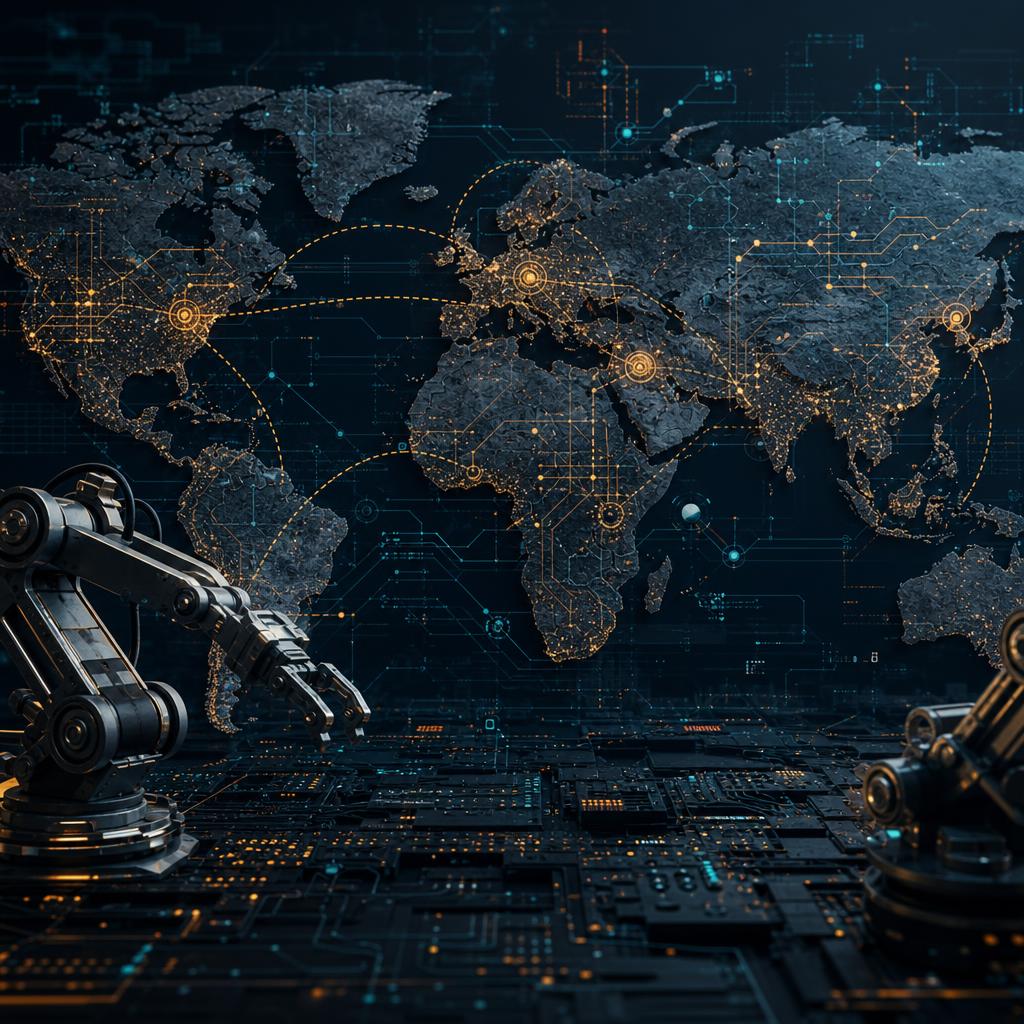
Geopolitical exposure matters everywhere. In deeptech, it can sink the company.
If you're joining a deeptech company, the thing most likely to decide its fate is probably the thing you've examined least.
Most folks, when they look at an offer, their due diligence normally comes down to the same metrics: how good is the product, how strong is the team, what's the market opportunity, the investors, cash burn rate, the comp, competitive risk. Etc. For the most part, that's actually enough, but looking at a broader landscape and assessing risk differently can really pay dividends.
Now that I'm spending more time in deeptech and AI infrastructure, I've started to learn about some of the other major market forces. I recently learned that China accounts for roughly 90% of the world's refining of materials that go into magnets in electric motors and robotic actuators.
When export controls tighten, the effects tend to be rapid. Look at Ford, which halted production at a US plant over a magnet shortage. Humanoid robotics programmes that hadn't even scaled yet felt it too, and prices for some materials moved several times over within months. Then the controls loosened, and the framework to reimpose them stayed exactly where it was.
Here we can start to agree that it's not so much about execution, but it's about how to make decisions when major variables are outside of your control, such as timelines and costs/pricing.
A lot of these events driving this are black swan events — as Morgan Housel has pointed out, The Economist's January 2020 and January 2022 forecast issues each set out a number of defining themes for the year ahead; neither mentions Covid or the Russian invasion of Ukraine. The usual risks — burn, litigation, competition — are ones you can watch develop and react to accordingly. An export restriction arrives as a step change: it either hits or it doesn't. You could say this isn't a new question at all, and that any competent senior executive is already asking it, but the point is these risks are becoming more frequent, and in a capital-intensive business, the impacts are harsher.
Now your evaluation has to ask the question it probably didn't before: does this company understand what it is exposed to, and can its leadership talk about it credibly?
Whatever you make of Elon Musk, he's been thinking this way for years. Tesla's vertical integration wasn't just a cost play — he was looking at controlling supply risk, on the logic that if a fraction of your suppliers aren't ready, you don't ship a car. His own competitors took that logic further — Chinese manufacturers integrated deeper into batteries and raw materials, and are now beating him in the market he defined.
His response shows how a leader behaves when the exposure turns against him. Rather than fight a supply-scale war he can't win, he's pivoting toward humanoid robots and autonomy, betting the next edge is a technical problem he can crack, like robotic hand dexterity, rather than a manufacturing-scale game. Whether that bet pays off is unknown, and it may not, but the instinct is worth borrowing: treat external risk as something you can use to reshape the company and gain a winning position.
Are the senior leaders in the company you're joining thinking like that? Maybe it's not your remit to think about these problems, but I would certainly want to be surrounded by individuals that do.
William Langdon-Banks advises founders, boards and senior executives across deeptech, robotics, mobility and AI infrastructure on leadership at the points where it matters most.
Key Search
Key Search specializes in expansion hires across Europe, the US, and transatlantic searches. To find out more about our US and North American hiring capability, visit us below.
This article and its photos were created with the use of A.I. and reviewed by a human Key Search Partner.
Related articles

Navigating the New Retail Frontier: Executive Leadership Trends in US & Canadian DTC and Retail Tech
The line between scrappy DTC upstarts and legacy giants has blurred to the point where it barely exists anymore. What separates the companies that win from the ones that stall is leadership — the right executives, at the right moment.

The Robotaxi Business Is an Energy Business
Waymo is running half a million paid rides a week. The technology works. The question now is whether a fleet of several thousand EVs can earn enough hours a day to justify the capital. That is not an autonomy problem — it is an energy and operations problem.
From Pilot to Platform: The Leadership Challenge in Warehouse Robotics
Building a robot that works is not the same as building a robotics company that scales. Here is why leadership, not technology, is the key constraint holding warehouse robotics companies back from platform-level growth.